
OPENING QUESTION: We have something like 5 or 6 different flavors of formulae for finding magnetic force... what are those?
30...29...28...27... etc ad nauseum
Now that you're all warmed up, please discuss with your group a scenario where a closed rectangular loop of wire would experience torque about an axis from the upper left corner to the lower right corner.
OBJECTIVES: I will be able to use the Biot Savart Law to set up an integral for finding magnetic field strength during today's class.
WORDS/FORMULAE FOR TODAY
TERMS
- Magnetic Field (B): A vector value
- Magnetic Force (FB): Also a vector
CONSTANTS:
μo = permeability of free space (which is a measure of how magnetic fields move through a vacuum... compared with the permaTIVITY of free space εo which is a measure of how electric fields move through a vacuum.
It may interest you to know that 1/(μoεo) = c2
UNITS:
- Tesla = T defined as 1 N/C(m/s)
FORMULAE:
- dB = (μoI/4π)(ds x r̂ )/r2 (note r here is the unit vector 'r' like i, j, or k) - once again our text diverges a wee bit from our equation sheet:
- FB = qv x B
- FB = qvB
- FB = qvBsinθ
- FB = IL x B
- FB = ∫I ds x B NOTE: AP Version is: FB = ∫I dℓ x B
- v = E/B
- τ = IAB (torque in a current carrying loop)
- τ = NIA x B (torque in a current carrying loop - vector version)
- τ = μ x B (torque in a current carrying loop - abbreviated version)
- KE = q2B2R2/2m
dB = (μoI/4π)(dℓ x r̂ )/r2 Also known as the Biot Savart Law. This version allows us to find a wee tiny bit of a B field. It is usually the first step in a two step process:
The second step is usually:
B = (μoI/4π)∫(dℓ x r̂ )/r2
where we take the integral of the first step AFTER we slice it and dice it a bit.
WORK O' THE DAY:
I am *remiss* at not acknowledging our resident kick-butt speech & debaters.... Let's hear it for Mr Yi, Mr Dean & Mr Shaw

════════════════════
M/c O' the Day:
Gaelan -- You're Up!
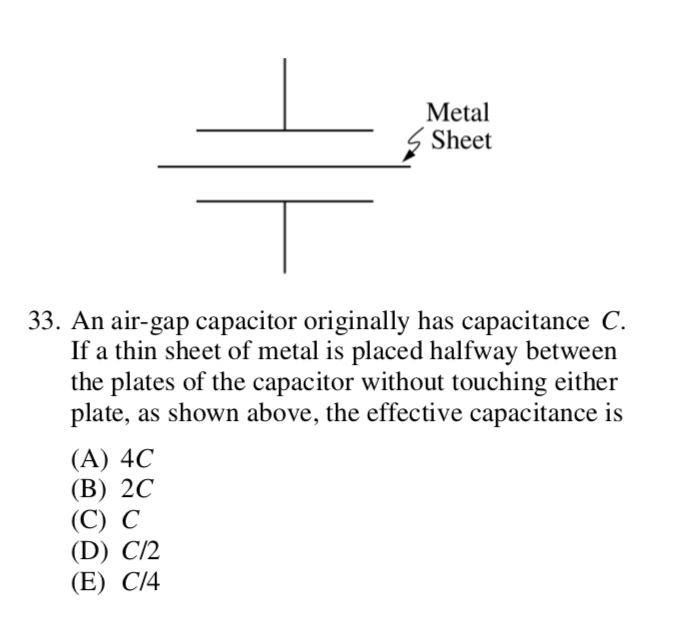
Released Exam
════════════════════
Let's volunteer a coupla folks to come up and provide cures to what ails on on yesterdays work...
MR W Inspirational Note: We've only got about 6 weeks folks... STAY frosty!
Some of you are really picking up your game, most hearty congrats to you folk!!
Some of you are sliding a touch....
Please DO NOT just do whatever homework I assign. I select those with the expectation that you've reviewed the day's lesson plan AND/OR the section in the book AND worked your way diligently through the examples I've outlined.
════════════════════
Having said that we're gonna get a WEE BIT NASTY as I like to say at such times:
Ladies and gentlemen, I give you the infamous Biot-Savart Law which allows us to find the magnetic field due to a moving charge:
dB = (μoI/4π)(ds x r̂ )/r2
or a whole bucket of charges (when we need to sum them up, which is, I dunno, like ALWAYS?):
B = (μoI/4π)∫(ds x r̂ )/r2
as you might expect, our AP C Equation Sheet prefers using ℓ:
dB = (μoI/4π)(dℓ x r̂ )/r2 (eq 1)
B = (μoI/4π)∫(dℓ x r̂ )/r2 (eq 2)
Notice how we use the differential form of the BS Law first, homogenize it and THEN dig in using the integral version.
In otherwords, get everything in terms of one variable first using (eq 1) then integrate that to get a value for ALL them little beasties (eq 2)
Notice the difference between r̂ and r. r̂ is the unit vector that we cross into to get the direction of the B field, while r is the radial distance to the point we are evaluating (in the direction of r̂ ).